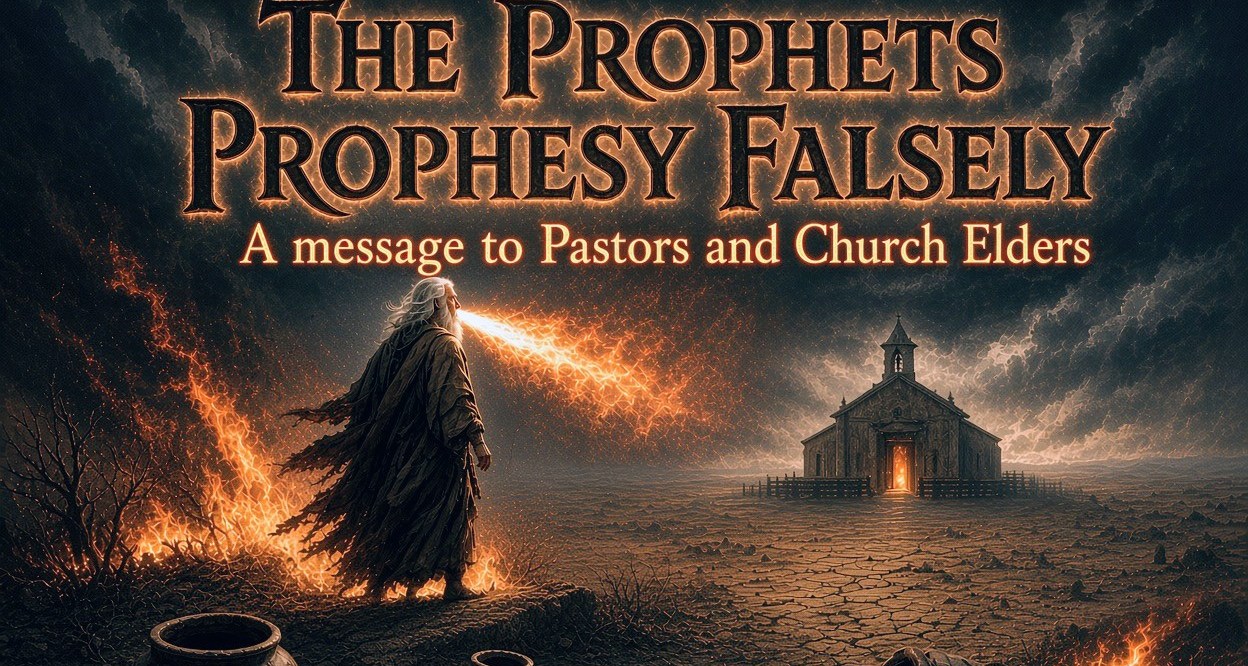
This is a message to Pastors and Church Elders – let me ask you something, and I want you to sit and think about it before you answer.
When was the last time you preached on sin?
Not sin in the culture, not sin “out there” in Washington or Hollywood or the school board – but sin in the pew?
When was the last time you called your people to repentance by name, and told them plainly that God is holy and they are not, and that the wrath of God is real?
If you have to think about it, you’ve already answered.
We have a generation of pastors who have decided that the way to grow a church is to make the gospel inoffensive.
We’ve traded the altar for the auditorium.
We’ve traded “repent” for “come as you are and stay as you are.”
We’ve traded the fear of the Lord for the fear of the giving report.
And Jeremiah – that weeping prophet nobody invites to the pastor’s conference – has something to say. He’s one of my favorites, and he’s the authority on this subject.
He was not addressing the world. He’s talking to us.
The Drought Is a Sermon
Jeremiah 14 opens with a drought, and God uses it as a picture of what happens to a people who will not repent.
“Judah mourns, And her gates languish; They mourn for the land, And the cry of Jerusalem has gone up. Their nobles have sent their lads for water; They went to the cisterns and found no water. They returned with their vessels empty; They were ashamed and confounded and covered their heads.” — Jeremiah 14:2-3
Look at that picture.
The nobles send their servants to the cisterns – the reservoirs, the places where water is supposed to be – and the vessels come back empty.
The plowmen are ashamed.
The deer abandons her newborn because there’s no grass.
Even the wild donkeys stand on the bare heights, sniffing the wind for rain that never comes, and their eyes fail.
That, dear Pastor, is a picture of the American church in 2026!
We have cisterns everywhere. We have buildings and budgets and branding. We have podcasts and production value and a sermon illustration for every occasion. And the people come to the cisterns and go home with empty vessels.
Why?
Because we stopped giving them the one thing that satisfies – the Word of God applied to their sin.
“Because the ground is parched, For there was no rain in the land, The plowmen were ashamed; They covered their heads.” — Jeremiah 14:4
The plowmen are ashamed.
Pastor, that’s you and me. We’re the ones who are supposed to break up the fallow ground. We’re the ones who are supposed to turn the soil so the seed can go in. And we have stood in the field with our hands in our pockets while the ground turned to concrete, because we were afraid that if we plowed too deep, somebody might leave!
Let me tell you something: they’re already leaving. They’re leaving empty. They’re leaving because a church that never names sin has nothing to save anyone from.
The Prophets Are Prophesying Lies
Now here’s where it gets uncomfortable. Jeremiah 14:13 – Jeremiah pushes back on God. He says, “Ah, Lord God! Behold, the prophets say to them, ‘You shall not see the sword, nor shall you have famine, but I will give you assured peace in this place.'”
Jeremiah is essentially saying, Lord, the people aren’t hearing this from me. They’re hearing the opposite from the other prophets. The other preachers are telling them everything’s fine.
And God’s answer is the heart of this whole message:
“The prophets prophesy lies in My name. I have not sent them, commanded them, nor spoken to them; they prophesy to you a false vision, divination, a worthless thing, and the deceit of their heart.” — Jeremiah 14:14
Pastor, hear this:
There is a difference between a man who has been sent and a man who has merely been hired.
There is a difference between a message that comes from the mouth of God and a message that comes from the deceit of a man’s own heart – a message that is smooth, and positive, and popular, and worthless.
“Therefore thus says the Lord concerning the prophets who prophesy in My name, whom I did not send, and who say, ‘Sword and famine shall not be in this land’—’By sword and famine those prophets shall be consumed!'” — Jeremiah 14:15
God does not merely disagree with the false prophets. He judges them first.
The sword and famine they promised would never come – that is exactly what consumes them. The judgment falls on the pulpit before it falls on the pew.
And then verse 16 – the people who sat under them are cast out in the streets, and there is no one to bury them. Their wives, their sons, their daughters.
The false teacher does not sin alone. He takes a congregation with him.
I want you to stew on that for a bit.
If you are preaching a gospel that never mentions repentance, you are not being kind to your people. You are being cruel to them. You are handing them a peace that God never authorized.
The People Love to Have It So
Now go to Jeremiah 5, because it tells us why this happens. It’s not just the preachers. It’s the market.
“Run to and fro through the streets of Jerusalem; See now and know; And seek in her open places If you can find a man, If there is anyone who executes judgment, Who seeks the truth, And I will pardon her.” — Jeremiah 5:1
God tells Jeremiah to go find one honest man. Just one. In the whole city.
And the implication is that he can’t find him.
Then look at verse 3 – this is the diagnosis of a people who have been preached to and are still unmoved:
“O Lord, are not Your eyes on the truth? You have stricken them, But they have not grieved; You have consumed them, But they have refused to receive correction. They have made their faces harder than rock; They have refused to return.” — Jeremiah 5:3
Stricken, but not grieved. Consumed, but not corrected. Faces harder than rock. That is a people who have been through hardship – a pandemic, an economic squeeze, cultural chaos – and have come out the other side more stubborn, not more repentant. Their hearts are hard. Their necks are stiffened,
And then the verse that ought to be nailed above every pulpit in America:
“The prophets prophesy falsely, And the priests rule by their own power; And My people love to have it so. But what will you do in the end?” — Jeremiah 5:31
My people love to have it so.
That’s the part we don’t want to admit.
The reason the American church has declined in preaching sin and repentance is not only that preachers stopped preaching it. It’s that congregations stopped wanting it. And too many of us made a deal with the devil – and the people: you don’t demand my repentance, and I’ll keep filling your seats.
But God asks the question that ends the negotiation: What will you do in the end?
The Fire in Your Mouth
Here is the promise that should terrify – and thrill every man reading this.
“Therefore thus says the Lord God of hosts: ‘Because you speak this word, Behold, I will make My words in your mouth fire, And this people wood, And it shall devour them.'” — Jeremiah 5:14
Notice the condition: because you speak this word.
Not because you speak a word.
Not because you speak a word that tickles ears and fills seats.
Because you speak this word – the word of the Lord, the word that names sin and calls for repentance and warns of judgment.
When you speak that word, God makes your mouth a fire, and the people wood. That’s the promise. Not that they’ll like it. Not that they’ll stay. That it will burn.
Yes, they’ll squirm in their seats – Good!
We have spent decades trying to make the Word of God safe. God never asked us to make it safe. He asked us to speak it.
They Have Refused to Return
Jeremiah 6 and 8 give us the same indictment from a different angle. In Jeremiah 6:10, God says the people’s ears are uncircumcised and they cannot listen – the word of the Lord is a reproach to them, and they have no delight in it. In Jeremiah 8:5-6, God asks:
“Why then have these people turned away? Why does Jerusalem always turn away? They cling to deceit; they refuse to return. I have listened attentively, but they do not say what is right. No one repents of his wickedness, saying, ‘What have I done?’ Each pursues his own course like a horse charging into battle.” — Jeremiah 8:5-6
No one repents, saying, “What have I done?”
That is the sound of a church that has lost the vocabulary of repentance.
We have programs for everything. We have a ministry for every need. We have counseling and recovery and small groups and conferences.
But somewhere along the way we lost the simple, devastating question that everyone – every pastor and elder – must ask themselves:
What have I done?
And Jeremiah 8:11 gives the reason:
“They have healed the wound of My people lightly, saying, ‘Peace, peace,’ when there is no peace.” — Jeremiah 8:11
That is the sin of the modern American pulpit in one verse.
We have healed the wound lightly.
We have put a band-aid on a cancer.
We have told people who are dead in their trespasses that they are basically fine and just need a little encouragement.
We have said “peace, peace” when God has said there is no peace.
The Shepherds Who Scatter the Sheep
Now turn to Jeremiah 23, because this is where God aims His sharpest words – not at the culture, not at the pagans, but at the shepherds.
“Woe to the shepherds who destroy and scatter the sheep of My pasture!” says the Lord. — Jeremiah 23:1
That word woe is not a suggestion. It is a curse. God is pronouncing judgment on the men He Himself appointed to feed His people, because they fed themselves instead.
“You have scattered My flock and driven them away, and have not attended to them. Behold, I will attend to you for the evil of your doings,” says the Lord. — Jeremiah 23:
And then the passage that ought to make every one of us tremble:
“For both prophet and priest are profane; Yes, in My house I have found their wickedness,” says the Lord. — Jeremiah 23:11
Not in the bars.
Not in the whorehouses or abortion clinics.
In MY house. In the house of God!
The wickedness God finds is among the prophets and the priests – the men who handle His Word and lead His worship.
“I have seen folly in the prophets of Samaria: They prophesied by Baal And caused My people Israel to err. Also I have seen a horrible thing in the prophets of Jerusalem: They commit adultery and walk in lies; They also strengthen the hands of evildoers, So that no one turns back from his wickedness.” — Jeremiah 23:13-14
Read that last line again.
They strengthen the hands of evildoers, so that no one turns back from his wickedness.
That is the charge. Not that the prophets were immoral in private – though some, probably a good many were. The charge is that their preaching made it easier for people to stay in their sin.
Their message strengthened the hands of the wicked instead of breaking them.
Their preaching gave people permission to keep going.
Pastor, I have to ask you: does your preaching strengthen the hands of evildoers?
When you avoid the hard text, when you soften the call to repentance, when you let your people believe that God is fine with them exactly as they are – you are not shepherding them. You are scattering them. And God says He will hold you accountable for it.
“Thus says the Lord of hosts: ‘Do not listen to the words of the prophets who prophesy to you. They make you worthless; They speak a vision of their own heart, Not from the mouth of the Lord. They continually say to those who despise Me, “The Lord has said, ‘You shall have peace'”; And to everyone who walks according to the dictates of his own heart, they say, “No evil shall come upon you.”‘” — Jeremiah 23:16-17
They make you worthless.
That is what a man-pleasing ministry produces. Not just empty seats – worthless people. People who have been inoculated against the real gospel by a counterfeit of it.
And then God’s own testimony about what His Word actually does:
“‘Is not My word like a fire?’ says the Lord, ‘And like a hammer that breaks the rock in pieces?'” — Jeremiah 23:29
If your preaching never burns and never breaks, if it doesn’t make them squirm in their seats, it is not the Word of God you’re preaching. It may be true things. It may be good things. But it is not this word.
The Remedy: Return
Now here is the mercy in all of this, because Jeremiah is not only a book of judgment. Jeremiah 23 does not end with woe. It ends with a promise:
“‘Behold, the days are coming,’ says the Lord, ‘That I will raise to David a Branch of righteousness; A King shall reign and prosper, And execute judgment and righteousness in the earth. In His days Judah will be saved, And Israel will dwell safely; Now this is His name by which He will be called: THE LORD OUR RIGHTEOUSNESS.'” — Jeremiah 23:5-6
That Branch is Jesus. That King is Christ. And the same God who says “woe to the shepherds” is the God who promised to send the Good Shepherd.
So here is the call, and it is not complicated:
Preach sin. Not as a cultural complaint, but as a personal indictment. Name it. Call it what God calls it. Let the hammer fall.
Preach repentance. Give your people the vocabulary they’ve lost. Teach them to say, “What have I done?” Teach them that repentance is not a one-time event but a way of life for the believer.
Preach the salvation message plainly. That Christ died for our sins according to the Scriptures, that He was buried, that He was raised on the third day – and that salvation is by grace through faith in Him alone, and that it includes the new birth and a call to follow Him as Lord.
It’s not a little prayer to pray.
It’s not a box to check.
It’s a life surrendered to a risen King.
And preach it to yourself first. Because the woe in Jeremiah 23 is aimed at us before it’s aimed at anyone else.
The plowmen are ashamed.
The shepherds are on trial.
Let the fire fall on your own heart before you ask it to fall on your people.
What Will You Do in the End?
Jeremiah 5:31 ends with a question that God has never answered for us, because it’s ours to answer:
“My people love to have it so. But what will you do in the end?”
You can keep the peace. You can keep the seats full. You can keep the offering plate passing and the people comfortable and the sermons safe. You can go another year without preaching on sin, without calling for repentance, without warning anyone of the judgment to come.
And in the end, the cisterns will still be empty. The ground will still be parched. The plowmen will still be ashamed. And the people you were afraid to offend will be scattered, with no one to bury them.
Or you can speak this word – and trust God to make your mouth a fire.
The choice is yours, pastor. But you will give an account for it.
“Do not be afraid of their faces, For I am with you to deliver you,” says the Lord. — Jeremiah 1:8
Now go – and preach.
To yourself first, then your people.


